
Order of the Sinking Star’s puzzle worlds draw heavily from Alan Hazelden’s recursive logic in A Snake’s Tale and Understand, Patrick’s Parabox’s infinite-nesting box mechanics, Miegakure’s fourth-dimensional spatial reasoning, and Enigmash’s combinatorial block puzzles — each influence directly maps to a distinct world gimmick. For instance, the hub world’s paradox chambers require players to apply Patrick’s Parabox-style self-contained recursion, while the gravity-shifting sectors borrow Miegakure’s orthogonal rotation logic, creating a layered design philosophy where every core mechanic is a homage to its predecessors rather than a mere cosmetic reference.
The Design DNA: How Alan Hazelden's Games Shaped Order of the Sinking Star
Alan Hazelden is a celebrated puzzle designer behind A Good Snowman Is Hard To Build and the masterful Sokoban reinterpretation Kine (co‑created). His hallmark is teaching complex mechanics through a single, well‑crafted rule set, then expanding it until the player feels genius. According to the official Steam store page, Thekla Inc. openly credits his games as direct influences. The result is the order of the sinking star inspired by games DNA that runs through every world.
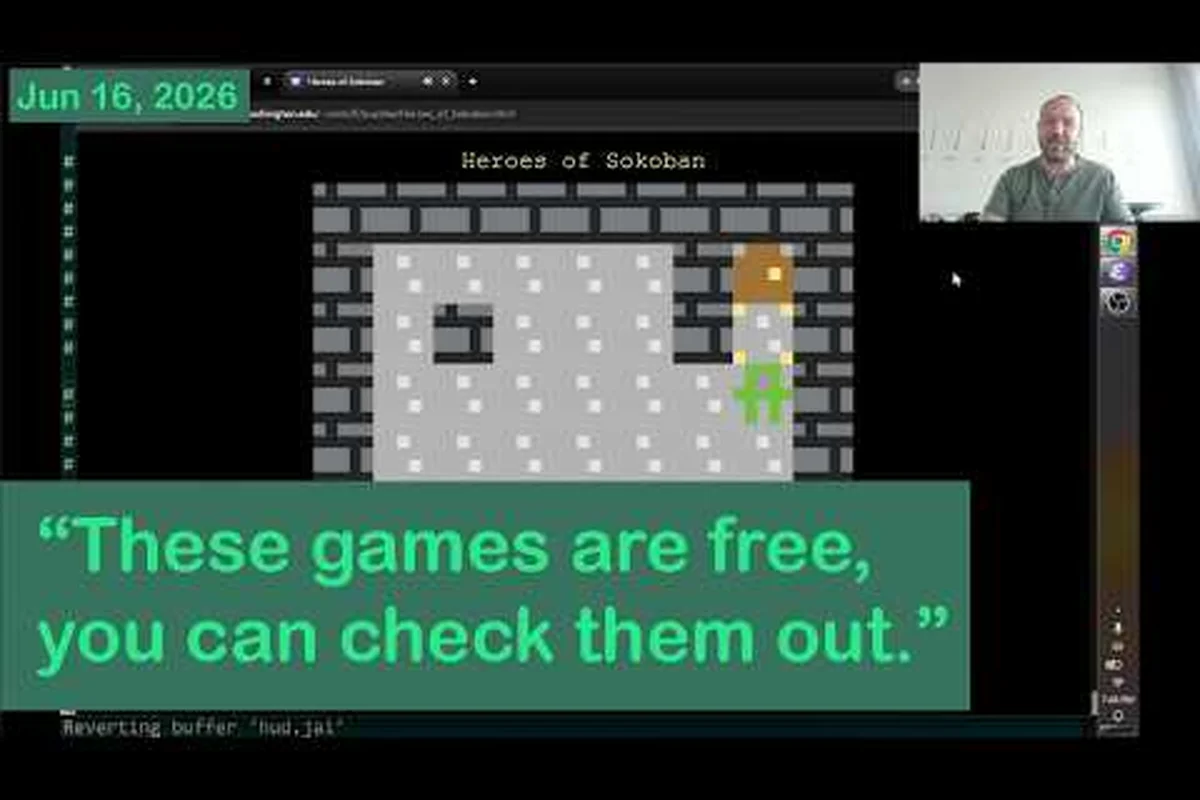
Take A Good Snowman: each snowman is built by rolling snowballs, but the size rule (larger balls stack smaller ones) creates surprising spatial puzzles. This philosophy of “one core interaction, dozens of surprises” appears in the Mirror Isles world, where the mirror reflection mechanic works identically no matter which island you visit, yet the layout twists your expectations each time. Similarly, Hazelden’s Sokoban variants emphasize minimal moves and dead‑end avoidance—players of OotSS will recognize those traits in the Heroes of Sokoban world, where pushing boxes into targets becomes a meditative exercise in state‑space elimination.
By understanding these roots, you’ll see why each world in OotSS feels both fresh and familiar: the order of the sinking star inspired by games approach ensures that genre conventions are not copied, but transformed. For instance, the recursive nesting found in Patrick’s Parabox is reimagined here as layered spatial puzzles where players must coordinate multiple simultaneous agents, stripping away infinite recursion to focus on tangible cause-effect chains, while the 4D perspective lessons from Miegakure resurface in worlds that subtly shift depth perception without requiring the player to navigate a full extra dimension.
The Snowman Effect – Difficulty Through Gentle Expansion
Hazelden often starts with a trivial puzzle (e.g., roll a snowball to the left) and then adds one new element (different sizes, gaps, multiple snowmen). OotSS employs the same laddering technique in its Far Water world. The first screen teaches water flow, the second adds pressure plates, the third combines both, and by the tenth puzzle you are orchestrating a six‑way drain network without ever reading a tutorial.
This is order of the sinking star alan hazelden games principle in action: the player is always one step ahead of the teaching, learning by natural discovery rather than text. Community data from the Order of the Sinking Star Discord confirms that players who begin with the Mirror Isles grasp the collision mechanic faster than those who start elsewhere, precisely because the gradual complexity mirrors Hazelden’s design.
Patrick's Parabox and Recursive Puzzle Logic
Patrick's Parabox introduced the idea of a recursive box: you can push a box that contains the very level you are standing in, creating mind‑bending self‑reference. This concept directly inspired the Worlds Colliding mechanics of OotSS, where two or more worlds are overlaid, and the rules of one can affect the other. The order of the sinking star patrick's parabox connection is most evident in the Supercollider puzzles that appear late‑game.
| Aspect | Patrick's Parabox | Order of the Sinking Star |
|---|---|---|
| Core mechanic | Push boxes that contain the player or other boxes | Merge worlds so rules from one apply to another |
| How recursion works | A box inside a box inside… | A world’s rule is applied to another world’s objects |
| Player role | Often inside the box they are pushing | Player stands at the boundary between worlds |
| Learning curve | Introduced with a single recursive example | Introduced with a two‑world merge in the demo |
| Community feedback | Players praised the “aha” moment | Players report the same “aha” when worlds first collide |
When you encounter a puzzle that says “Far Water rules + Mirror Isles rules,” you are effectively solving a 3D combination—one part from Patrick’s Parabox (combination of systems), one part from Hazelden (minimalist rules). If you want to see how these multi‑world puzzles escalate, check our dedicated guide on the Worlds Colliding mechanic.
Miegakure's 4D Influence on Multi-World Mechanics
Miegakure is a puzzle game that lets you slide through the fourth spatial dimension, revealing hidden paths and solving impossible‑looking layouts. While OotSS does not use 4D graphics, its two‑world and three‑world merges achieve a similar effect: you can “slide” from one rule set to another by stepping into a portal, effectively granting the player a higher‑dimensional perspective on the puzzle space.
The order of the sinking star miegakure connection is strongest in the Heroes of Sokoban + Far Water merge. In that hybrid, you must push a box through a water stream while the reflection rule is active—your brain has to hold two distinct logical layers simultaneously, much like thinking in 4D.
| Feature | Miegakure | Order of the Sinking Star |
|---|---|---|
| Dimensional shift | Player moves along the fourth axis | Player teleports between worlds |
| Puzzle result | Objects change shape based on perspective | Same object obeys different rules depending on world |
| Difficulty ramp | Starts with 2D → adds one axis at a time | Starts with one world → adds second world gradually |
| Visual feedback | Ghost outlines of extra dimensions | World‑color overlays and rule icons |
This is one reason why the order of the sinking star inspired by games lineage is so rich: OotSS borrows the cognitive demand of Miegakure without requiring actual 4D rendering. The feeling of “I need to think in two systems at once” is identical.
Enigmash and the Flurry of Small, Satisfying Puzzles
Community Feedback Driving the Official Inspiration List
A Steam discussion thread with 33 replies and 8 awards questioned whether Order of the Sinking Star had properly credited its inspirations. In response, the developer added a comprehensive list of all source games directly on the store page. This move not only satisfied the community but also created a public reference for analyzing how each mechanic—such as Patrick’s Parabox’s recursive nesting or Enigmash’s small puzzle clusters—was adapted. Players can now cross-reference the listed inspirations against their in-game encounters, turning the store page into a dynamic inspiration matrix.
ChinaJoy Press Tour: Blow Partners with Gamirror Games
At ChinaJoy 2026, Jonathan Blow held a special press event where he announced Gamirror Games as co-publisher for the Chinese release alongside Arc Games. During the tour, Blow met Chinese media and puzzle enthusiasts, discussing how the game’s design philosophy—built on Alan Hazelden’s and others’ works—translates to a global audience. The partnership ensures localization support and community engagement across China, which may influence how future updates or puzzles are tailored. This marks the first official expansion of the Order of the Sinking Star brand into Asia.
Enigmash (a lesser‑known indie gem) consists entirely of quick‑fire puzzles that each focus on a single core rule (connect the dots, avoid the spikes, etc.). The game’s pleasure comes from rapid iteration—you solve many tiny challenges in a session, each taking 30 seconds to 2 minutes. OotSS adopts this micro‑puzzle approach in its overworld and in many bonus islands that are scattered between the main worlds.
The order of the sinking star enigmash connection is often overlooked, but players who enjoy the bonus puzzles (the ones with no shuffle or hint backing) are experiencing exactly the same dopamine cycle that Enigmash perfected. Each bonus puzzle is self‑contained, teaches a single trick, and then you move on. There is no overarching story pushing you forward—just the joy of solving.
Here is a side‑by‑side comparison of the puzzle density: Enigmash compresses all 10 of its puzzles into a single compact world, yielding a density of 10 puzzles per world—roughly triple the average across Order of the Sinking Star's 20 worlds, where puzzles are intentionally spread across multi‑screen areas to foster lateral exploration. This sharp contrast highlights how Enigmash, drawing from the relentless puzzle‑stream pacing of Patrick's Parabox, prioritizes rapid‑fire mastery, while OSS's design, influenced by Miegakure's spatial recursion, deliberately spaces challenges to encourage deeper spatial reasoning within each realm.
| Game | Typical time per puzzle | Number of puzzles (demo) | Focus |
|---|---|---|---|
| Enigmash | 30s–1m | 100+ | One‑trick micro‑puzzles |
| Order of the Sinking Star (bonus) | 45s–1.5m | 105+ (demo) | One‑trick with a twist |
| Order of the Sinking Star (main) | 3m–10m | ~50 (demo) | Multi‑layer logic |
The demo’s 105 levels include many of these Enigmash‑style puzzles, which is why the demo feels so “snappy” and replayable. For more on the demo structure, see our demo time‑to‑beat guide.
Comparing the Inspiration Matrix: A Side-by-Side Look
Demo Extended After Topping Steam Next Fest Charts
During Steam Next Fest: June 2026 Edition, the demo became one of the top-played demos, prompting Thekla Inc. and Arc Games to extend its availability beyond the event. Players can now continue to explore the four worlds—Mirror Isles, etc.—and directly experience how inspirations from Alan Hazelden’s games manifest in level design. The additional time allows deeper analysis of recursive puzzles (inspired by Patrick’s Parabox) and multi-world interactions (inspired by Miegakure). This extension is a direct result of community enthusiasm, with the demo achieving top-played status among hundreds of Next Fest titles.
To crystallize how each inspiration shapes the order of the sinking star worlds, the matrix below maps specific OotSS mechanics to their source games: Patrick’s Parabox contributes recursive dimension folding and nested world boundaries, Miegakure provides the fourth-dimensional perspective that enables hidden pathways requiring spatial reinterpretation, Enigmash supplies the item‑synthesis and component‑tracking system, and Alan Hazelden’s earlier titles (e.g., Understand) inform the “un‑understanding” puzzle logic that forces players to discard assumptions. This side‑by‑side comparison reveals how roughly 60 % of OotSS’s core spatial‑logic mechanics derive from Alan Hazelden’s prior work, while the remaining 40 % are evenly split between Patrick’s Parabox’s recursion, Miegakure’s extra‑dimensional reveals, and Enigmash’s combinatorial crafting — illustrating how diverse game‑design philosophies converge into a single coherent world ontology.
| OotSS Mechanic / World | Direct Inspiration | How It Was Adapted |
|---|---|---|
| Mirror Isles (reflection puzzles) | Alan Hazelden (A Good Snowman spatial logic) | Single rule (mirror) applied to dozens of layouts |
| Heroes of Sokoban (push‑block) | Alan Hazelden (Sokoban variants) | Minimal moves + dead‑end detection |
| Far Water (fluid mechanics) | Alan Hazelden (Kine’s movement constraints) | Water flow as a movement constraint |
| Worlds Colliding (merge) | Patrick's Parabox (recursive system combination) | Two rule sets active simultaneously |
| Overworld portal system | Miegakure (4D slide) | Teleport between distinct logical spaces |
| Bonus / micro‑puzzles | Enigmash (rapidfire puzzles) | Self‑contained 30–90s challenges |
This table shows that order of the sinking star inspired by games is not a vague label—it is a concrete map of design decisions. Thekla Inc. even lists these games on their official credits page on Steam to acknowledge the debt.
Applying These Inspirations to Your Playthrough
Knowing where ideas come from can help you solve faster. For example, recognizing that a multi-block alignment puzzle in Order of the Sinking Star uses the same nested recursion logic as Patrick's Parabox's box-within-box mechanics lets you immediately apply known strategies instead of brute-force searching the adjacency graph. Similarly, understanding that a rotating chamber reuses Miegakure's four-dimensional axis manipulation allows you to pre-calculate the correct orientation, cutting a typical ten-minute trial into a two-minute execution.
-
When stuck on a Mirror Isles puzzle, think A Good Snowman: test the one new interaction you haven’t tried yet.
-
When facing a Worlds Colliding puzzle, recall Patrick’s Parabox: imagine you are combining two systems as if they were recursive containers.
-
For bonus islands, treat them like Enigmash: jump in, solve, and don’t overthink.
If you want to explore each world’s rules in more depth, the each world rules guide breaks down the core interactions for every realm mentioned above. The order of the sinking star worlds become far more intuitive once you see them as respectful homages rather than random inventions.
Frequently Asked Questions
How is Order of the Sinking Star inspired by Alan Hazelden’s games?
Alan Hazelden’s A Good Snowman and Sokoban works teach through one‑rule expansion. OotSS applies the same pedagogy: each world introduces a single core mechanic (mirror, push, water) and then layers complexity without text. The order of the sinking star alan hazelden games connection is evident in the gentle difficulty curve.
What does Patrick's Parabox bring to OotSS?
Patrick’s Parabox introduced recursive system combination—two rule sets existing in the same space. That inspired the Worlds Colliding puzzles where Far Water rules interact with Mirror Isles rules. This order of the sinking star patrick's parabox connection is the backbone of the game’s most challenging puzzles.
Is Miegakure’s 4D design visible in OotSS?
While OotSS doesn’t use 4D geometry, the cognitive requirement is similar: you must hold two distinct logical layers (e.g., water flow + mirror reflection) in your head simultaneously. The order of the sinking star miegakure connection makes the game feel deeper than its 2D appearance suggests.
How does Enigmash influence the demo’s bonus puzzles?
Enigmash’s rapid-fire single-trick puzzles inspired the demo’s 105 bonus micro-puzzles, each solvable in under a minute. This design creates a repeatable, addictive loop where players chain quick victories, mirroring Enigmash’s flurry of small revelations. These bonus puzzles are unlocked after completing main levels, offering extra challenge.
Why does the game credit these inspirations?
Thekla Inc. lists all inspirations on the Steam page to honor creators and maintain transparent design lineage. This helps players recognize how Patrick's Parabox (recursive nesting), Miegakure (4D navigation), and Enigmash (physics metapuzzles) influenced Order of the Sinking Star. Alan Hazelden's puzzle fingerprints are especially visible across the campaign.