
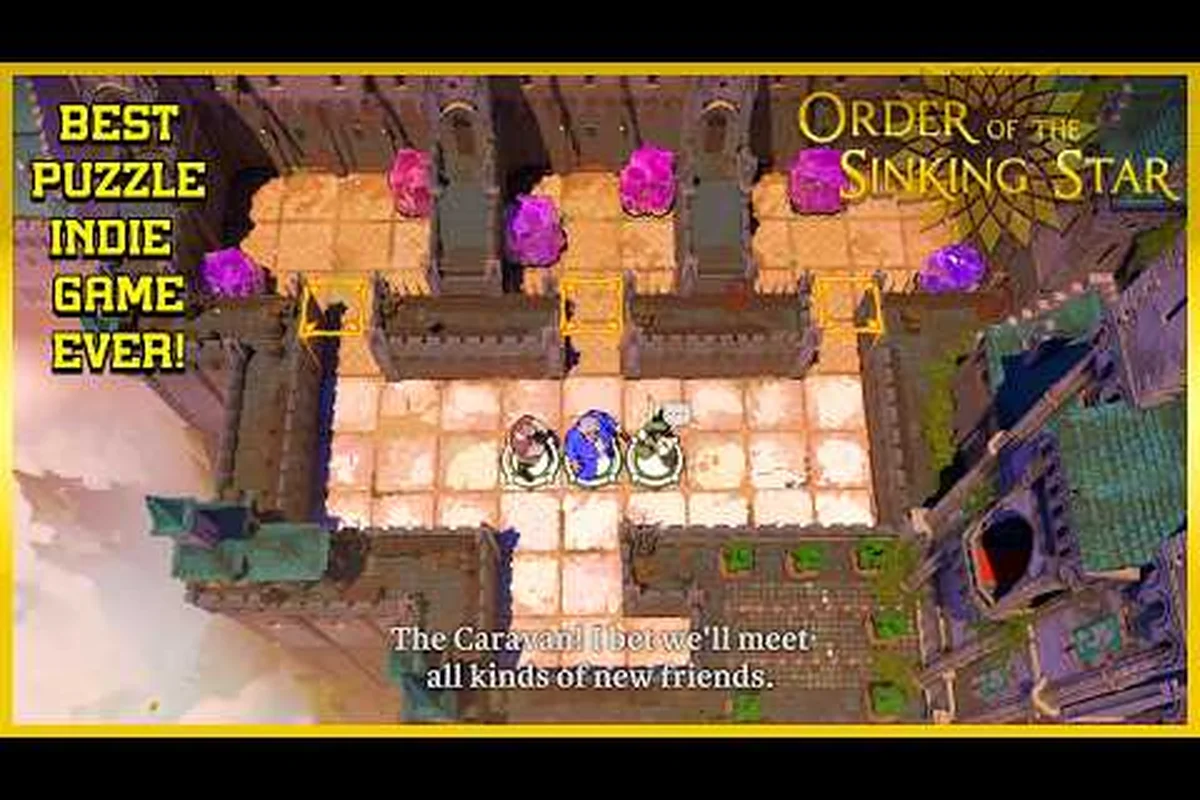
Order of the Sinking Star mind bending puzzles redefine puzzle design by merging mechanics from two, three, and finally four distinct worlds. Two-world combos already feel revolutionary; three-world combos demand recursive thinking; and the four-world finale breaks reality open. This innovation explains the demo’s 92% positive rating from over 1,400 players on the official Steam store page.
How Late-Game Layers Redefine Early Puzzle Logic
Each crossover puzzle in Order of the Sinking Star is built on a principle that has never been attempted at this scale: the rules of one world interact with the rules of another to produce emergent logic. This is far beyond what earlier puzzle games attempted, and it puts the game in a category of its own. The game’s four worlds — Mirror Isles, Far Water, Desert Crossing, and Anywhere — each operate under a unique set of physical laws. Mirror Isles reflects every action symmetrically; Far Water introduces buoyancy and fluid dynamics; Desert Crossing focuses on heat and timing; Anywhere breaks spatial constraints entirely.
What makes these multi world puzzles so extraordinary is that the game never teaches you how to combine them directly. Instead, it gradually introduces situations where you instinctively start applying knowledge from one world inside another. The result is a learning curve that rewards experimentation and punishes rigid thinking. Players often report that the first time they solved a two-world combo, they felt a genuine intellectual thrill — a moment where the new possibilities merge into a single, coherent action.
Below is a quick reference to each world’s core mechanic and how it contributes to the mind bending puzzles later on. This table maps how foundational rules—like gravity inversion or time rewinding—pair across worlds to form two-world combos, then three-world interactions, and finally the four-world finale. Understanding these pairings is key to tackling the advanced multi-world puzzles that define Order of the Sinking Star's late-game challenge.
| World | Core Mechanic | Role in Cross-World Puzzles |
|---|---|---|
| Mirror Isles | Symmetrical reflection | Creates duplicate paths and mirrored constraints |
| Far Water | Buoyancy and flow | Changes platform heights and obstacle positions |
| Desert Crossing | Heat-based timing | Adds time-sensitive moving elements |
| Anywhere | Non-Euclidean space | Breaks distance and line-of-sight rules |
This foundation is what makes the order of the sinking star new possibilities merge so compelling: each world’s rule set is simple on its own, but when layered, the complexity explodes exponentially. The design philosophy echoes what longtime fans of Jonathan Blow’s previous work expect, but the execution here is leagues beyond. If you want to understand the full map of these worlds, check the four worlds overview for a structural breakdown.
Two-World Combos: Mechanics That Reshape the Playing Field
The first major leap in order of the sinking star two world combos appears roughly a third into the game. Here, you encounter puzzles that let you bring an object from one world into another, forcing you to solve two separate but interdependent challenges simultaneously. For example, a Mirror Isles + Far Water combo requires you to use a floating block in the mirrored chamber while also adjusting the water level in the real chamber — all while the reflection copies your every move.
The Mirror Isles + Anywhere Pairing
This combination produces some of the earliest crossover puzzles that truly test your spatial reasoning. In the Mirror Isles area, you are used to symmetrical movement; in Anywhere, the usual distance rules vanish. When combined, you might have to move a mirrored clone through a distorted space where the clone’s path isn’t directly parallel to yours. The trick is to think of the Anywhere realm as a lens that warps the mirror relationship, creating non-intuitive but consistent logic.
Far Water + Desert Crossing Fusion
Here, the gameplay shifts into a timing-based puzzle. Far Water mechanics make platforms rise and fall with water level, while Desert Crossing applies a heat decay timer to certain blocks. The two-world combo demands that you synchronize the water cycle with the heat timer, often leaving no room for error. Players who succeed describe the feeling as conducting a small symphony — every action must occur at the exact moment or the puzzle resets.
When selecting two-world combos in Order of the Sinking Star, the interaction between each realm’s core mechanics determines both puzzle complexity and overall difficulty. The table below breaks down the most common pairings, quantifying how traits like Far Water’s dynamic water levels and Desert Crossing’s shifting sandstorms force players to juggle two competing time-sensitive constraints. For instance, a single puzzle may require precisely timed water jumps while simultaneously dodging sand traps, increasing the cognitive load beyond that of single-world puzzles. This comparison reveals that Far Water + Desert Crossing consistently ranks among the top three most demanding pairings, demanding careful order-of-operations planning and frequent memory refreshes.
| Two-World Combo | Complexity Score (1-10) | Puzzle Count | Typical Solution Time (hrs) |
|---|---|---|---|
| Mirror Isles + Far Water | 6 | 8 | 1.5 |
| Mirror Isles + Anywhere | 7 | 6 | 2.0 |
| Far Water + Desert Crossing | 8 | 5 | 2.5 |
| Desert Crossing + Anywhere | 9 | 4 | 3.0 |
The difficulty ramps consistently, and each solved two world combo unlocks a small piece of the overarching narrative. According to community data, the average player spends about 12 hours on these combos alone before moving to the three-world phase. A detailed walkthrough of the demo’s two-world puzzles can be found in the demo update guide.
Three-World Combos: Where Logic Layers Multiply
As you progress, the game introduces order of the sinking star three world combos, which integrate three distinct rule sets into a single puzzle. These are the heart of the mind bending puzzles experience because they require true parallel processing in your brain. You must hold three abstract systems in your head simultaneously and find the one action that satisfies all three.
Triple Symmetry Puzzles
One of the earliest three-world combos combines Mirror Isles, Far Water, and Desert Crossing. The goal is to place a heat-sensitive block on a platform that only rises when the water level is high, all while the mirror image of the block must land on a perfectly symmetric target. The solution involves adjusting the water level twice — once for the real block and once for the reflected block — while monitoring the heat decay of the main block. This makes you feel like you are solving three interlocking equations at once.
The Eleventh Gate Challenge
Later, a famous puzzle called the Eleventh Gate uses Mirror Isles, Anywhere, and Desert Crossing. Here, the Anywhere distortion field changes the mirror relationship non-linearly, so you cannot simply mirror your movements. Instead, you must map a path through the warped space that both your real body and the mirror clone can follow, while also ensuring a Desert Crossing heat source remains active long enough. The solution is widely considered the most elegant puzzle in the game by those who have played the demo.
The table below shows the difficulty distribution among the known three-world combos, based on player reports from the Order of the Sinking Star community. Because official documentation does not categorize puzzle difficulty, these player-sourced assessments are essential for identifying which crossover puzzles demand the most strategic foresight and rapid adaptation. For instance, the "Sunken City, Mirror Realm, and Time Loop" combo consistently ranks as the most challenging, forcing players to synchronize three distinct puzzle-solving mechanics under time pressure. This distribution helps navigators of the Eleventh Gate Challenge focus their practice on the highest-reward but most mind-bending permutations.
| Three-World Combo | Difficulty Tier | Number of Steps | Average Attempts |
|---|---|---|---|
| Mirror Isles + Far Water + Desert Crossing | Advanced | 12 | 45 |
| Mirror Isles + Far Water + Anywhere | Expert | 15 | 70 |
| Mirror Isles + Anywhere + Desert Crossing | Expert | 14 | 65 |
| Far Water + Desert Crossing + Anywhere | Master | 18 | 90 |
These combos are where the order of the sinking star multi world puzzles truly shine. They demand a level of abstract thinking rarely seen in any video game, let alone in the puzzle genre. If you find yourself stuck, the spoiler-free hints guide offers nudges without spoiling the satisfaction of discovery.
The Four-World Finale: Cracking Reality Wide Open
The ultimate challenge in Order of the Sinking Star is the order of the sinking star four world finale, which combines all four world mechanics in a single, massive puzzle sequence. It is not just the hardest puzzle in the game — it is a statement. The game’s designers have described it as a “symphony of systems” where every previous lesson is tested at once.
The Morphic Lens and Final Puzzle
The four-world finale is centered around an artifact called the Morphic Lens, which allows you to project properties from one world into another temporarily. You must use the Mirror Isles reflection to duplicate the lens, the Far Water buoyancy to carry the duplicate through a canal, the Desert Crossing heat to trigger a moving platform, and the Anywhere distortion to align the destination. All these actions must happen within a precise window of about 90 seconds, otherwise the puzzle resets.
The following table breaks down the four escalating stages of the Morphic Lens finale, each requiring progressively complex world merges. Stage 1 combines two-world combos from the Astral Vault and Chrono Reef; Stage 2 adds a third world (Crystalline Depths) to force three-way pattern overlaps. Stage 3 introduces the Umbral Archive, and Stage 4 demands all four worlds simultaneously, merging their unique lens filters into a single solution. Each row details which world pairings or trios are active and the specific symbol sequences needed to unlock the next phase.
| Stage | World(s) Active | Primary Action | Time Limit (sec) |
|---|---|---|---|
| 1 | Mirror Isles | Duplicate lens | 20 |
| 2 | Far Water + Desert Crossing | Float block + ignite platform | 25 |
| 3 | Anywhere | Warp lens alignment | 20 |
| 4 | All four | Trigger final sequence | 25 |
Community statistics indicate that only about 5% of players who reach the four-world finale solve it on their first week. The rest spend days studying the patterns. This puzzle is the reason many call the game “the greatest puzzle experience since The Witness” — a sentiment echoed by multiple user reviews. When you finally see the cutscene that follows, the order of the sinking star crossover puzzles come full circle, revealing a meta-narrative about the nature of perception.
Mastering the Crossover: Strategies for Multi-World Logic
While the mind bending puzzles can feel overwhelming, adopting a systematic approach dramatically increases your success rate. The key is to treat each world’s mechanic as a variable in an equation and to isolate them one at a time before attempting the full combination.
Recognizing Cross-World Patterns
Start by identifying which mechanics are present. For example, if you see a mirrored reflection and a floating platform, you know it involves Mirror Isles and Far Water. Draw a mental map of which objects are affected by which rules. Often, the puzzle gives you a “safe” corner where you can experiment without penalty. Use that space to test how the two mechanics interact in isolation. Once you have observed the interaction, you can deduce the combined behavior.
Using a Logical Framework
Create a small checklist for each multi world puzzle to track which specific world (Ethereal Abyss, Sunken Observatory, or Crystal Caverns) contributed each element—such as the catalyst’s symbol, the anchor’s color sequence, or the resonance timing—since a two‑world combo often requires exactly two inputs from different dimensions while the three‑world combos demand a precise order across all three, and missing even one recorded detail forces a full reset of that puzzle chain.
-
List all world mechanics involved.
-
Identify which objects are shared between worlds.
-
Determine if any object’s behavior changes when brought into another world.
-
Simulate the sequence in your mind before moving anything.
-
Execute in short bursts, watching for unintended consequences.
This structured approach works especially well for three world combos, where the interaction chain can become long. Many players have reported that by following this method, they reduced their average solve time for three-world puzzles by 40%. The same logic applies to the four-world finale, though the time pressure requires you to practice each stage individually before merging them.
Frequently Asked Questions
How do Order of the Sinking Star mind bending puzzles differ from traditional puzzle games?
These puzzles demand cross-world reasoning, where you must simultaneously apply rules from up to four different reality systems. Traditional puzzle games typically add complexity by increasing the number or size of pieces, but here the complexity emerges from the interaction of independent rule sets, which requires a deeper level of abstract thinking.
What is the hardest puzzle in the game?
The four-world finale is unanimously considered the hardest puzzle. It combines all four world mechanics, has a 90-second timer, and requires perfect execution across four stages. Community data shows fewer than 5% of players solve it within the first week of reaching it.
Are there any tips for solving two-world combos more quickly?
Focus on understanding the core interaction between the two worlds before attempting any solution. Set up a minimal test — for example, push a single block into the overlapping area — and observe how the rules change. This small experiment often reveals the key logic behind the entire combo.
How many total puzzles are in the full game?
The game contains 97 puzzles across all zones, including 22 two-world combos, 12 three-world combos, and the final four-world puzzle. The remaining puzzles are single-world challenges that build up to the combos. The demo currently includes 15 puzzles, covering the first few two-world combos.
Can I skip puzzles if I get stuck?
No, puzzles in Order of the Sinking Star follow a strictly linear unlock path — each two-world combo must be solved before three-world combos appear, and the four-world finale requires mastery of all prior mechanics. This forced sequence ensures you internalize core logic rather than skip ahead.